
| his-story | ||||||||||
 |
 |
 |
 |
 |
 |
 |
 |
 |
 |
 |

Full Circle
by Tony Dawson
I was 18 years old and gasping for breath. A drunken American postgraduate student was holding me down on the floor of the Common Room, doing his best to choke the life out of me because he found my Cockney humour insufferable. Then, just as I was about to pass out, a muscular Nigerian MA student pulled him off. The American’s name was O. J. (Jim) Emory, known to us all in Woodsley Hall - a University of Leeds student residence - because he had brought an LP of Tom Lehrer’s witty songs with him from the United States. As far as I know, that was the limit of Emory’s fame. The brawny Nigerian who rescued me was Wole Soyinka, a budding writer whose room was opposite mine on the first-floor landing. I still have a copy of the March 1957 issue of The Gryphon, the Journal of the University of Leeds, which contains one of his earliest stories, entitled “A Tale of Two Cities”. Some twenty-nine years later, in 1986, Wole attained worldwide fame when he became the first African Nobel Laureate in Literature.
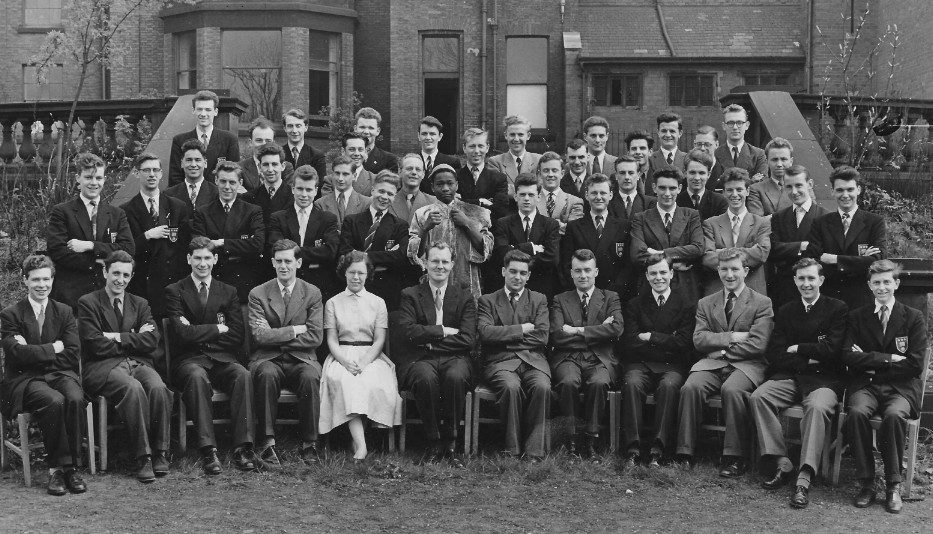
Every one of the forty-three students living in Woodsley Hall had been interviewed by John Woodhead, the warden, who was a large man and rather camp in his mannerisms. He taught phonetics at the university. I was acutely aware, because of my social background, that “It is impossible for an Englishman to open his mouth without making some other Englishman hate or despise him”, as George Bernard Shaw’s character, Professor Henry Higgins, says in GBS’s 1912 play, “Pygmalion”, so I immediately signed up for Woodhead’s classes. While he was obviously gay - to use twenty-first century terminology - and periodically mocked by Wole, who would leave a trail of talcum powder from the bathroom to the warden’s door, he maintained the heterosexual appearances necessary in the 1950s by being seen as often as possible in the company of Mademoiselle Thyss (pronounced ‘Teece’ but inevitably changed by the students to ‘Thighs’). A member of the French Department, at a strapping six feet tall with a dark moustache, she was only slightly shorter, but more manly, than her male companion.
Woodsley Hall. Tony is standing in the second row, third from the right wearing a light-coloured sports jacket.
The warden seemed to approach the selection of Woodsley’s residents with the aim of achieving as broad a sociological mix as possible: There were plenty of young men from the Yorkshire bourgeoisie, a few students from overseas and a blend of Arts, Science, Engineering and Medical students. I was a rarity for that day and age, being a working-class Londoner on a scholarship studying Spanish and subsidiary French with Portuguese. In those days of very few universities, it was not often that people from my less than privileged background gained entry to higher education.
Although the University of Leeds had only three thousand students at that time and was best known for its Engineering Departments and Medical School, it also sponsored the Arts, in part because it had a particularly strong English Literature Department chaired by A. Norman Jeffares and a Linguistics Department headed by Professor P. D. Strevens. There was also an endowment funded by and named after Eric Craven Gregory, the chairman of the publishing and printing firm Lund Humphries, which provided Gregory Fellowships to give financial support and workspace for young and mid-career poets, musicians, artists, painters, and sculptors. The first Gregory Fellow in poetry was James Kirkup, who was awarded the Fellowship, if I understand correctly, on the strength of his work “A Correct Compassion”. However, it seems to me that his poetry never really developed into anything worthwhile after that, perhaps because of his prodigious output, which had a ‘never mind the quality, feel the width’ feel about it. This opinion is reinforced by the fact that his “Prodigal Son” was eviscerated by Thom Gunn in the latter’s 1961 Poetry Foundation critique. Kirkup was followed in the post by Jon Silkin, a more substantial poet, who, in the 1950s, could be seen promoting his poetry magazine, Stand, around the Students’ Union.
It transpired that the University was nurturing another poet in its student ranks, an undergraduate named Tony Harrison. Although he was there at exactly the same time as me, but reading Classics, our paths didn’t cross. However, by a strange quirk of fate, I was to meet both Kirkup and Harrison in Spain, although many years apart and under different circumstances. When I spent the third year of my university course in Salamanca, from the beginning of October 1957 until the end of July 1958 as an English Language Assistant in the Colegio Mayor Universitario Fray Luis de León (a student hall of residence), I coincided with James Kirkup who had been appointed Visiting Professor of English at the University and was lodged in the same Colegio. For James, though, Franco Spain proved to be an insurmountable obstacle course, both linguistically and culturally.
For a start, he had no knowledge of Spanish, which made his interaction with everybody else awkward, to say the least. As far as I know, his academic qualifications were in French and German. Nevertheless, his biggest drawback was that he was a very obvious camp homosexual and became intimately involved with a young American, Andrew (Dana) Orke, who was in Salamanca on a Comparative Literature bursary and attended Kirkup’s classes. However, the young man was not a resident of the Colegio, so Kirkup used to invite him to his room where they started writing poems together using the pseudonym, Andrew James. Apart from the fact that homosexual practices in those days were illegal throughout Europe, in Franco Spain “queer bashing” was a pastime for Nationalist thugs. Within the college itself, the Colombian students immediately concluded that James and his American friend were involved in suspect activities and that “writing poetry” was just a cover. They burst into Kirkup’s room one day, expecting to find him and Dana engaged in nefarious practices. Of course, they were disappointed, but it was no surprise when, shortly after, James asked me to explain to the Director of the residence that he had moved out. Within a few weeks, he resigned from his university post because, in the meantime, he had managed to secure a teaching post in Japan.
Years later, in 1976, James became particularly notorious (although there are other descriptors that could be applied) for his poem “The Love That Dares to Speak Its Name” addressed to Christ on the cross and published in Gay News. It became a cause célèbre in a blasphemy case brought by Mary Whitehouse against the poem’s publisher. She was, let’s say, straitlaced and well-known in her day for her social conservative activism. Mary Whitehouse was the embodiment of a reaction against the swinging sixties. As for James, my impression of him was that he was queer in the softest of ways. He liked the ambiance of the queer community because, on the one hand, it gave him the thrill of association, and on the other it enabled him to live out his fantasies by writing about it even though, as he stated in one of his autobiographies, he found homosexual practices literally distasteful. Similarly, he liked the idea of being called ‘a poet’, however mediocre his poems actually were, because of the term’s aura. After spending close to thirty years teaching in Japan, he retired to Andorra, where he spent his time writing obituaries, mainly for the UK newspaper, The Guardian. Moreover, as he explained in the volume of autobiography entitled “A Poet Cannot But Be Gay”, he still missed Dana every day. He remained in Andorra until his death in Les Bons at the age of 91. His ashes, though, are buried in Kyoto, Japan.
As for Tony Harrison, by the time he visited Spain in about 1998, I was an Associate Professor (a grandiose title for a very minor post) in the Department of English Language at the University of Seville. He had come to give a reading of a selection of his poems. It proved to be one of the most inspiring experiences that I can remember. His recital of “A Kumquat for John Keats” and “Them and Uz”, particularly, still stick in my mind. The audience gave him a standing ovation when he had finished.
It was at that point that I began to feel that I would like to try my hand at writing ‘real’ poetry, by which I mean other than lampoons. Attempting to write real poetry takes a certain amount of courage because it exposes the writer to criticism by those better at the craft. The first poem of mine that was published was entitled Lithuanian Cat’s Cradle, which can be found online. In it I was settling a score with someone that I had had an affair with back in 1972-73 and which had turned out badly. The poem appeared in Volume 25, Number 2, 2013 of Critical Survey. At the time, I was in the fortunate position of having the poet and novelist, John Lucas, an old schoolfriend of mine, as poetry editor of the magazine. He also ran his own small publishers, Shoestring Press in Nottingham, England. Then came a hiatus in my writing and it wasn’t until COVID struck in 2019, which forced us all to spend so much time confined to our homes, that I took up writing in earnest to maintain my sanity. In 2020, John Lucas published my poem Embers as a small booklet. It also included a brief explanation of how it came to be written. From then on, my writing burgeoned. So far, I have published three small collections: Afterthoughts ISBN: 978-81-19228-34-8 in 2023, Musings: Poems by Tony Dawson Published by Impspired ISBN 978-19-15819-66-6 also in 2023 and Reflections in a Dirty Mirror. Poems and Short Fiction by Tony Dawson Published by Impspired ISBN 978-19-15819-94-9 in 2024.
Since then, I have compiled two more collections, A Spanish Sketchbook and Delicious Decay but have yet to find a publisher for them. Unfortunately, my former publisher, Steve Cawte of Impspired, died at the tragically early age of 41 last year. I am so grateful to him for the effort he made to guide me through the labyrinthine process of compiling collections and getting them published. Now, at the age of 89, and not yet gasping for breath (again), I am still constantly thinking of themes and experiences to write about, which is, I believe, the hallmark of anyone who has been bitten by the writing bug.

Rate this story.

Copyright is reserved by the author. Please do not reproduce any part of this article without consent.